6 HS Code Classification Rules Master Before Customs Declaration.
Detailed 6 HS code classification rules by WCO to help businesses classify import/export goods accurately, reducing duty risks and customs delays.
Looking up HS codes should not be done by intuition, let alone relying solely on the commercial product name on an invoice or supplier's description. A single product can go by many commercial names, but for customs declaration, the HS code must be determined based on the nature of goods, chapter notes, heading/subheading descriptions, and classification rules.
This is why declarants must master the 6 HS code lookup rules before declaring. These rules provide a clear classification logic, rather than picking codes by habit, Google search, or old experience.
Why master the 6 HS code lookup rules before declaring?
An HS Code is not just a sequence of numbers filled on a declaration. The HS code directly affects import duty, VAT, product policies, licenses, specialized inspection, C/O and related documents.
In practice, many errors arise because the declarant only looks at the commercial name. For example, 'coffee' can refer to unroasted green coffee beans, roasted ground coffee, or 3-in-1 instant coffee, all of which have different HS codes, leading to different tax rates and regulatory conditions.
Therefore, before using any lookup tool, businesses should understand basic HS Code classification principles. If you need a broader workflow, check out the article on how to look up HS codes to understand the path from product description to declared code.
| Rule | Core Content | When to Use |
|---|---|---|
| Rule 1 | Based on chapter notes, heading and subheading descriptions | First step in classifying goods |
| Rule 2A | Incomplete, disassembled, or blank products | When goods are unfinished but have the essential character of finished goods |
| Rule 2B | Mixtures or combinations of multiple materials | When product consists of multiple ingredients or materials |
| Rule 3A | Prefer headings with the most specific description | When goods can belong to multiple headings |
| Rule 3B | Classify by the component giving the essential character | When goods are retail sets, combos, or multi-material |
| Rule 3C | Choose the heading that appears last in numerical order | When Rules 3A and 3B cannot be applied |
| Rule 4 | Classify by the most-akin goods | When cannot be determined by previous rules |
| Rule 5A | Specially shaped cases, boxes, and containers | When packaging is designed specifically for the product |
| Rule 5B | Ordinary packaging | When packaging is only used for packing and transport |
| Rule 6 | Compare at the same subheading level | When going from heading to subheading and detailed code |
Rule 1: Read chapter notes and legal descriptions before choosing a code
Rule 1 is the foundation of the entire HS determination process. Section, chapter, or sub-chapter titles only help the declarant orient where the goods might be located in the tariff. However, these titles are not enough to conclude the final HS code.
Declarants need to read section notes, chapter notes, heading and subheading descriptions. This is the only basis for determining whether the goods actually belong to the chapter or heading under consideration.
For example, a product may look like it belongs to a certain chapter, but the chapter notes exclude that product and lead to another chapter. Conversely, if the tariff has a very specific description for the product, and the notes do not exclude it, the declarant can prefer that description.
Rule 2: Unfinished goods and mixtures
Rule 2A: Incomplete, disassembled, or blank products
Rule 2A applies to incomplete, unfinished, disassembled or unassembled articles, and blanks. If an unfinished article has the essential character of the complete or finished article, it is classified as if it were finished (e.g., a car missing its wheels is still classified as a car). This rule also applies to disassembled goods imported for transport convenience (such as knock-down furniture). However, if the goods require significant further processing or have excess parts not needed for assembly, this rule does not apply.
Rule 2B: Mixtures and combinations of materials or substances
Rule 2B applies to mixtures and combinations of materials or substances. If a product consists of multiple ingredients or materials belonging to different headings (e.g., 3-in-1 instant coffee consisting of coffee, sugar, milk powder, creamer), it cannot be classified by looking at individual components alone. One must determine which material or component gives the product its essential character and how it is marketed and used by consumers.
Rule 3: When goods can belong to multiple headings
Rule 3A: Prefer headings with the most specific description
The heading which provides the most specific description shall be preferred to headings providing a more general description. For example, an electric shaver or hair clipper could fall under electric hand tools, but the tariff contains a specific heading for 'Shavers, hair clippers and hair-removing appliances, with self-contained electric motor,' which must be preferred.
Rule 3B: Classify by the component giving the essential character
Applies to mixtures, composite goods consisting of different materials, and goods put up in sets for retail sale. Such goods are classified according to the material or component that gives them their essential character. The essential character may be determined by primary function, role in the set, value, quantity, weight, or material. For example, a coffee gift set containing roasted coffee, an aluminum filter, a glass cup, and a spoon. If the buyer chooses the set mainly for the coffee, then the coffee is the component providing the essential character for classifying the entire set.
Rule 3C: Choose the heading that appears last in numerical order
When goods cannot be classified under Rule 3A or 3B, they shall be classified under the heading which occurs last in numerical order among those which equally merit consideration. This is a last resort and only applied after thorough comparison yields no result under 3A and 3B.
Rules 4, 5 & 6: Most-akin goods, packaging and subheadings
Rule 4: Classify under the heading appropriate to the goods to which they are most akin
Rule 4 is used when goods cannot be clearly classified according to previous rules. In this case, the product is classified under the heading appropriate to the goods to which they are most akin in terms of description, characteristics, composition, functions, and intended use. This is common for new or unique products not explicitly described in the tariff.
Rule 5A: Specially shaped cases, boxes, and containers
Applies to specially shaped cases, boxes, bags, or containers designed to hold a specific article or set of articles, suitable for long-term use and presented with the articles for which they are intended. These containers are classified with the articles they contain (e.g., a glass case presented with glasses, a musical instrument case). However, if the container gives the whole its essential character (very high value or distinct independent use), it should not be classified with the main product.
Rule 5B: Ordinary packaging
Applies to packaging materials and packing containers normally used for packing and imported with the goods (such as plastic bags, cardboard boxes, PP bags). Ordinary packaging is classified with the goods inside. However, this rule is not binding for packaging suitable for repetitive use.
Rule 6: Compare at the same subheading level
Rule 6 is used when classifying goods at the subheading level. After determining the correct 4-digit heading, classification into subheadings (6-digit or 8-digit) must be done by comparing subheadings at the same level (e.g., a one-dash subheading should only be compared with another one-dash subheading). Do not rush to choose codes without drilling down to the correct level.
Example of applying the 6 rules to coffee HS code lookup
Suppose a business needs to declare unroasted Robusta coffee beans, not decaffeinated, in 60kg bags for export. This seems simple, but if the description is unclear — green beans, roasted, instant, or a gift set — the classification direction can differ.
With Rule 1, the declarant needs to check the chapter and headings related to coffee, while reading descriptions carefully to determine: unroasted vs roasted, decaffeinated vs not.
With Rule 2A, unroasted green coffee is not disassembled goods or a product blank. However, if it were a disassembled coffee roaster, we should apply this rule.
With Rule 2B, if the goods are pure coffee, mixtures rarely arise. But for 3-in-1 instant coffee, we must consider the ingredients and the product's essential character to apply Rule 2B.
With Rule 3B, if the goods are a gift set of coffee, filter, cup and spoon, we determine which component gives the essential character. If the buyer chose it primarily for coffee, coffee is the key element.
With Rule 5B, a PP or jute 60kg sack is typically ordinary packaging for transport and storage, which does not alter the goods' nature.
Finally, Rule 6 requires the declarant to drill down to the subheading level to distinguish unroasted vs roasted, decaffeinated vs not, before concluding the detailed code.
How to mitigate risks when determining HS codes
To mitigate risks in HS code determination, businesses should standardize product information before lookup. Product descriptions must be comprehensive: not just the commercial name, but also materials, composition, functions, processing state, packaging, catalogs, images, and related documents.
Declarants should also document the classification basis, including chapter notes, heading/subheading descriptions, reasons for excluding other codes, and reasons for choosing the final code. This documentation helps businesses defend their classification during customs audits or reviews.
For complex items, companies can use supporting tools for a quick initial assessment. You can perform an AI-powered HS code lookup on Gexim to get suggested classification directions, necessary reference notes, and verification points before filing.
FAQ
Must the 6 HS code lookup rules be applied in order?+
What is the difference between Rule 2A and Rule 2B?+
When is Rule 3C used?+
Can I look up an HS code by product name only?+
Conclusion
The 6 HS code lookup rules are a critical foundation for logical product classification rather than guesswork. Understanding Rules 1, 2A, 2B, 3A, 3B, 3C, 4, 5A, 5B, and 6 significantly reduces the risk of incorrect codes, wrong duties, or lack of classification basis in customs declarations.
Before declaring, start with clear product descriptions, check chapter notes, compare at the correct subheading level, and save the classification basis. For complex goods, you can try AI-powered HS code lookup on Gexim for helpful directions before entering the HS code on your declaration.
Tăng tốc độ tra cứu & Phân loại mã HS bằng GEXIM AI
Dựa trên cơ sở dữ liệu hải quan và biểu thuế cập nhật mới nhất, Gexim AI giúp bạn đối chiếu, phân tích bản chất hàng hóa và gợi ý mã HS chính xác chỉ trong vài giây.
Tags
More articles
View all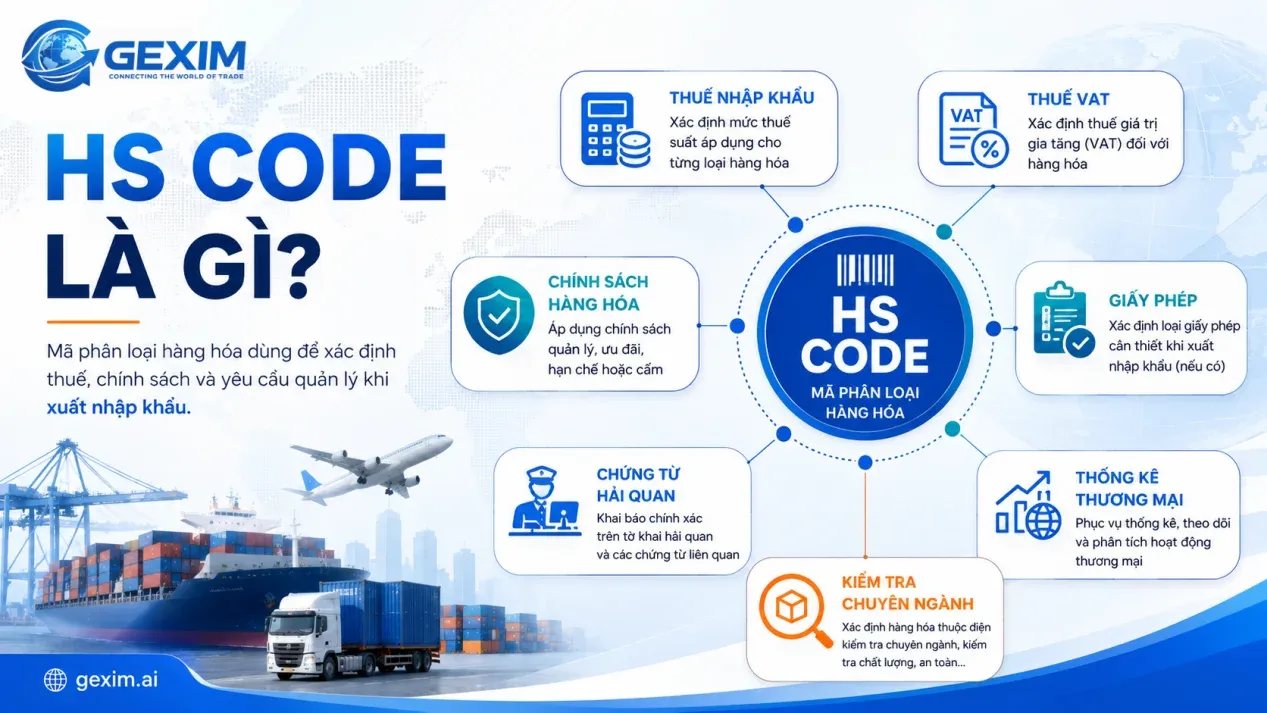
What is an HS Code? Structure and usage in import & export
An HS Code is a product classification code used in trade. Learn about the HS code structure, its digits, and its impact on duties and trade policies.

How to look up HS codes accurately for import & export goods
A 5-step HS lookup workflow, official sources to use, common mistakes and how to apply AI to reduce classification errors.

Top online HS code lookup websites and how to verify reliable sources
Recommended reputable websites for online HS code lookup such as Customs, VNTR, WCO, WTO, USITC, Access2Markets and how to use GEXIM for faster check.
Suggested content you might be interested in
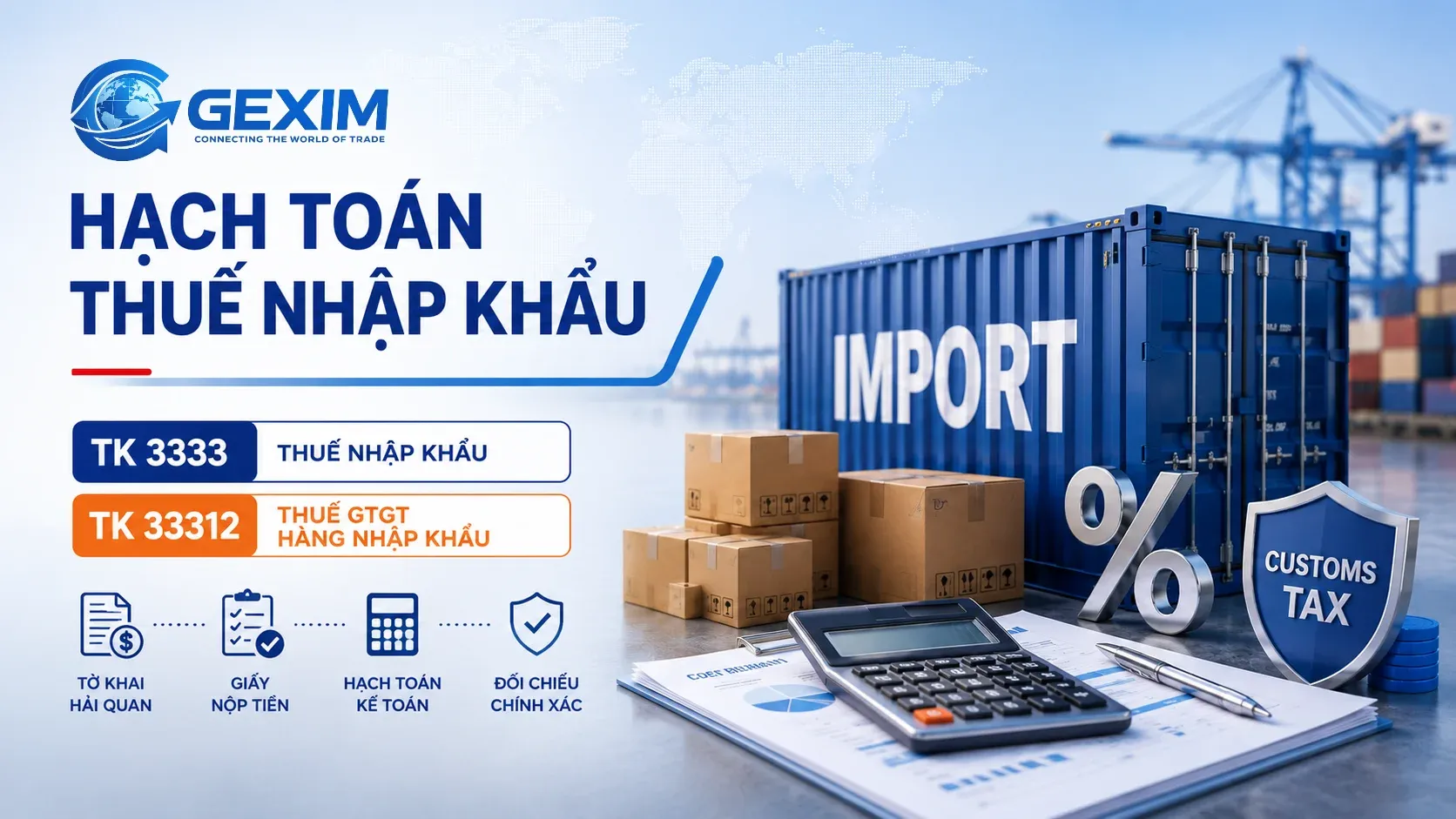
Accounting for import duty and import VAT: Account 3333, Account 33312
Detailed guide on accounting for import duty (Account 3333), import VAT (Account 33312), tax payments, and accounting reconciliation.

How to calculate import duty on goods entering Vietnam: formulas, examples and a checking workflow
The import-duty formula, how to set the dutiable value, how import VAT is computed, worked examples and a pre-declaration checking workflow.
What is the import customs value? Determining the customs value, CIF, FOB and exchange rates
What the import customs value is, why not to use the raw invoice price, how to determine it from CIF/FOB, the customs exchange rate and a document checklist before computing duty.