How to look up HS codes accurately for import & export goods.
Verify official sources, cross-check Vietnam's 8-digit codes and use AI to cut classification errors — a 5-step workflow you can apply to real shipments.
Misclassifying an HS code can mean wrong duty calculation, wrong policy treatment, document supplements or delayed clearance. Looking up HS codes should never stop at typing a product name into an online tool and picking the first result.
For traded goods, the HS code must be determined from the product's nature, function, material, construction, technical documents and the current regulations. Especially for items with many variants or easily confused with neighbouring groups, a clear lookup procedure dramatically reduces declaration risk.
This article walks you through how to look up HS codes step by step, the information you need to prepare, the official sources to use, common mistakes, and how an AI like Gexim.ai can make the check faster and more systematic.
What is an HS code?
An HS code is the code used to classify goods in international trade. HS stands for Harmonized System — the Harmonized Commodity Description and Coding System, widely adopted by countries as the basis for customs tariffs and trade statistics.
Put simply, the HS code lets customs and businesses speak the same language about which group an item belongs to. With the right classification, authorities can determine the duty rate, import policy, specialised inspection requirements and related conditions.
So when looking up HS codes for imports or exports, don't stop at the 4- or 6-digit level if the declaration is to be filed in Vietnam. See also: What is an HS Code? Structure and usage in import & export
How HS codes affect duties and policy controls
Per Customs Law 2014, Article 26: classifying goods to determine the code number is the basis for assessing duties and applying management policies. The HS code drives preferential import duty, VAT, special consumption tax (if any), specialised permits, quality inspection, quarantine and conformity certification.
Why you shouldn't search by product name alone
The same commercial name may map to multiple codes depending on material, function, construction, composition, condition and intended use. A “controller” could be electrical, mechanical, industrial-machine or electronic module — the technical construction decides the HS code, not the name.
Why HS codes must be accurate
Newcomers to trade often think the HS code is just for calculating duties. In reality, it affects many steps across import, export and clearance.
Per Customs Law 2014, Article 26: classifying goods to determine the code is the basis for assessing duties and applying management policies. Classification must be based on the customs file, technical documents and relevant information about the traded goods.
If the wrong code is applied, businesses may face:
- Wrong import duty, export duty or VAT amount.
- Need to file supplementary declarations and adjust documents.
- Shipment held back for inspection or required explanation.
- Extra time spent coordinating with forwarders, customs, consultants or suppliers.
- Risk of retroactive tax collection if the wrong code understated the duty.
- Impact on delivery schedules, inventory and operating costs.
For frequent importers, a wrong HS code isn't a single-shipment problem. If the same item is misclassified across many shipments, the risk compounds over time.
What information should you prepare before looking up an HS code?
Accurate HS lookup doesn't start at a lookup site — it starts with understanding the goods. Commercial names like “machine accessory”, “controller”, “filter device”, “fabric”, “powder”, “cable” are far too broad — the same name can map to many code groups.
| Information Group | Clarification Needed | Example |
|---|---|---|
| Product name | Commercial and technical name | Blender, electric motor, pressure regulating valve |
| Main function | What is the item used for | Household, industrial, medical, production |
| Material | Main composition of the goods | Plastic, steel, aluminum, cotton, alloy |
| Structure | What parts make up the goods | Motor, circuit board, casing, blades, sensor |
| Specifications | Power, size, model, capacity | 220V, 500W, 1.5L, model ABC |
| Product status | New, used, component set, finished good | 100% brand new, replacement parts |
| Related documents | Catalogue, datasheet, invoice, packing list | Technical documentation from supplier |
| Product photos | Real photos, label, sticker, model | Product photo and brand label |
This is also where AI can assist very well. With Gexim.ai, users can input product descriptions, product documents, or information from invoices, images, and descriptions for the system to help standardize the data before lookup. However, AI should be viewed as an analytical assistant, not the final legal authority.
How to look up HS codes step by step
To reduce risk, run a multi-step lookup process instead of a single Google search. Below is a practical workflow you can apply in trade operations.
Step 1 · Identify the goods' true nature
Before searching, answer this: what is the item actually? Raw material, component, part, machine, finished equipment or consumer product?
Then clarify the primary function. For many items, the function matters more than the commercial name. A “filter”, for instance, can serve water, oil, air, industrial machines or medical equipment — each maps to a different code group.
At this step, read the catalogue, datasheet, photos and supplier description carefully. If anything is unclear, follow up with the supplier before assigning a code.
Step 2 · Search using multiple keyword variants
Don't rely on a single keyword. Search with multiple variants: Vietnamese name, English name, material, function, industry group, technical/catalogue name.
A “pressure reducing valve”, for instance, can be searched as “regulating valve”, “valve for pipeline”, “industrial valve”, “gas valve”, “water valve”. Each angle may surface a different code group worth comparing.
VNTR offers an HS lookup tool and the Vietnam import/export catalogue — a solid reference for finding the right group.
See also: Top online HS code lookup websites and how to verify reliable sources
Step 3 · Cross-check 6-digit vs Vietnam's 8-digit code
The international HS code is standardized at the first 6 digits. For declarations in Vietnam, businesses must use the 8-digit code from Vietnam's import/export catalogue.
After locking down the 6-digit group, cross-check the 8-digit level. The last two digits can affect duty rates and policy treatment.
Never take a code from a foreign website and apply it directly to a Vietnamese declaration without rechecking.
Step 4 · Check tariff schedule and policy controls
Once a candidate code is chosen, check the tariff schedule and policy controls. The Vietnam Customs portal has a tariff lookup and the import/export catalogue database.
Verify: preferential import duty, VAT, export duty (if any), special consumption tax (if applicable), specialised management policy, permits / quality checks / quarantine / conformity certification.
Not every item is just code-plus-duty. Some require specialised regulations — skip this step and you may arrive at the port with missing documents.
See also: Customs HS Code Lookup: Official Sources & Verification Methods
Step 5 · Archive the classification rationale
A good HS code isn't just one that “looks right” — it's one you can defend.
Once selected, archive: the chosen HS code, declared product name, technical description, catalogue / datasheet / images, reasoning behind the choice, codes compared and rejected, sources used, date checked, person responsible.
This archive supports re-review when internal disputes, customs requests or supplier changes arise.
Six HS code classification rules to master before declaring goods
HS code lookup should not be based on intuition or product name alone. A single product can have many commercial names, but for customs classification, the HS code must be determined from the true nature of the goods, chapter notes, heading and subheading descriptions, and the classification rules applied in order.
Before declaring traded goods, businesses should master the six HS lookup rules. According to the reference material, they cover: chapter notes and specific descriptions; incomplete or mixed products; goods classifiable under several headings; most-akin goods; packaging; and the same-level subheading comparison rule. Rule 2 has sub-rules 2A and 2B; Rule 3 has 3A, 3B and 3C; Rule 5 has 5A and 5B.
Specifically:
- Rule 1: Classification is determined by the terms of the headings and relative section or chapter notes. This is the foundational rule and is always prioritised.
- Rule 2(a): Incomplete or unfinished goods that already have the essential character of the finished product shall be classified as finished.
- Rule 2(b): Goods made of mixtures or combinations of different materials shall be classified according to the principles of mixtures.
- Rule 3(a): When goods are classifiable under multiple headings, the most specific description shall prevail.
- Rule 3(b): For mixtures, composite goods or sets, classify by the component that gives the goods their essential character.
- Rule 3(c): When 3(a) and 3(b) fail, classify under the heading that appears last in numerical order among those considered.
- Rule 4: Goods that cannot be classified under the prior rules shall be classified under the heading for the most-akin goods.
- Rule 5(a): Specially shaped cases and containers suitable for long-term use and sold with the product shall be classified with it.
- Rule 5(b): Ordinary packing materials and containers sold with the goods shall be classified with them, unless suitable for repetitive use.
- Rule 6: Subheading classification is determined by the subheading terms and related notes, compared only at the same level.
To understand each rule in detail with practical applications, refer to: 6 HS Code Classification Rules: Master Before Customs Declaration
Sources to use for HS code lookup
Not every online source is reliable enough for customs declarations. When looking up HS codes, prioritise official or legally grounded sources.
Circular 31/2022/TT-BTC
Circular 31/2022/TT-BTC issues Vietnam's import/export catalogue — effective from 01/12/2022. This is the key source when you need to check the catalogue structure and classification rules. When in doubt, cross-check against the catalogue rather than relying on a quick-lookup tool.
Vietnam Customs portal
The Vietnam Customs portal has tariff lookup and the import/export catalogue database — use it to verify information for actual declarations.
VNTR
VNTR provides an HS lookup tool and the Vietnam import/export catalogue — handy for quick keyword search and description cross-checking.
Product technical documents
Official sources aren't only legal documents. For each item, the catalogue, datasheet, product photos and technical specifications matter too. Ask suppliers to send complete documentation before import — especially for machinery, equipment, chemicals, electronic components, industrial goods or items prone to specialised inspections.
| Source | When to use | Notes |
|---|---|---|
| Circular 31/2022/TT-BTC | Check Vietnam's import/export catalogue | Foundational document for the current catalogue (effective 01/12/2022) |
| Vietnam Customs portal | Look up tariffs and the import/export catalogue database | Use to verify official information |
| VNTR | Look up the Vietnam import/export catalogue | Convenient for cross-checking codes and descriptions |
| Product technical documents | Establish the goods' true nature | Essential for complex items: machinery, chemicals |
| Expert / customs consultant | When the code is unclear or risk is high | Recommended for high-value items and codes prone to disputes |
Common HS code lookup mistakes
Even with many lookup tools available, HS misclassification remains common. Here are mistakes to avoid.
Searching only by commercial name
Commercial names in quotes, invoices or catalogues are rarely enough for customs classification. A “controller”, for instance, could be electrical, mechanical, industrial-machine or electronic module — the technical construction decides the HS code.
Picking a lower-duty code without grounds
HS codes must follow classification rules, not duty optimisation wishes. To optimise import cost, check origin, FTA benefits and C/O rather than misclassifying.
Not checking codes against the current version
The HS catalogue is updated over time. The WCO HS Nomenclature 2022 took effect 01/01/2022. Old data, old Excel files and codes sent by partners years ago must be re-verified before declaration.
Not comparing closely similar codes
Many items have multiple similar codes. A solid process compares them, recording why you picked one and why you ruled out the others — this is your defence when challenged.
Not archiving classification history
If you import regularly and start from scratch every time, it's slow and inconsistent. Build an internal HS library: code, description, technical documents, verification source, update history.
Should you use AI for HS code lookup?
AI can be a strong support for HS lookup, provided you understand its role. AI shouldn't be treated as the final legal decision-maker. Use it as an assistant to standardise descriptions, read documents faster, suggest related code groups and remind you to check for missing inputs.
Many classification errors come from vague inputs, not from a lack of lookup tools. Typing only “filter machine”, “electric device”, “plastic accessory” or “machine part” will produce poor results in any tool.
AI can help reframe with the right questions:
- What is this item used for?
- What is the main material?
- Is it a finished product or a component?
- Is there a catalogue or datasheet?
- Which industry does it serve?
- Is there a model number or technical spec?
- Are there similar HS codes worth comparing?
Example: HS lookup workflow for a product
Suppose your business needs to import a household blender. Rather than searching “blender” and picking the first result, follow this workflow.
- 1Identify true nature: household electric appliance with motor, jar, blades — used to grind household food.
- 2Gather technical info: power, voltage, jar capacity, jar material, model and supplier catalogue.
- 3Search with multiple keywords: “blender”, “máy xay sinh tố”, “household food grinder”, “electric food preparation appliance”.
- 4Cross-check Vietnam's 8-digit code, tariff schedule and related policies.
- 5Archive the candidate code, reasoning, catalogue, photos, specs and verification sources.
Checklist before declaring an HS code to customs
Before using an HS code on a declaration, run through this quick checklist:
- Item name, function and true nature are clearly identified.
- Catalogue, datasheet or technical documents are available.
- Material, construction and key specifications have been checked.
- Multiple keyword variants have been searched.
- Group descriptions were read, not just the code names.
- Closely similar HS codes have been compared.
- Vietnam's 8-digit code has been verified.
- Tariff schedule and management policies have been cross-checked.
- Lookup source and verification date are recorded.
- Reasoning for the chosen code is recorded.
- Expert consulted if the item is complex or high-risk.
How Gexim.ai helps with HS code lookup
In trade, HS lookup isn't just matching a number to a name. It drives import duty, FTA benefits, legal alerts, required documents and risk on declaration. Gexim.ai provides an intelligent HS advisor that classifies faster, with better evidence and lower risk than manual lookup.
See also: Guidance on looking up HS codes with Gexim AI - fast - accurate
Flexible data input
Snap a product photo, paste a catalogue description, enter the 8-digit HS code directly, or upload an Excel/CSV file for bulk classification.
Clear 4-step workflow
AI analyses material, shape, structure, packaging, function and intended user — suggesting an 8-digit AHTN code group for you to confirm.
Early risk alerts
The system flags prohibited items, trade defence, CITES, quarantine and specialised permits — caught before opening the declaration, not after goods arrive at port.
Connected to duty, C/O, documents
Once the HS code is confirmed, Gexim.ai checks import duty, C/O benefits, landed cost and related documents in the same workflow. How to calculate import duty on goods entering Vietnam | What Is Landed Cost
Try Gexim.ai for free
Standardize product descriptions, validate shipment data and shorten HS code lookup to just minutes.
FAQ on HS code lookup
What's the most accurate way to look up HS codes?+
How many digits does a Vietnamese HS code have?+
Where can I look up HS codes online?+
Is AI accurate for HS code lookup?+
What's the impact of getting the HS code wrong?+
Conclusion
Looking up HS codes accurately isn't about finding a number fast — it's about building a defensible process. Understand the goods, prepare technical documents, search multiple sources, cross-check Vietnam's 8-digit code, verify the tariff and archive the reasoning.
An AI like Gexim.ai makes the process faster, more systematic and easier to manage — standardising descriptions, suggesting code groups to check, archiving classification history, and connecting to other steps such as import duty calculation or landed cost.
Tags
More articles
View all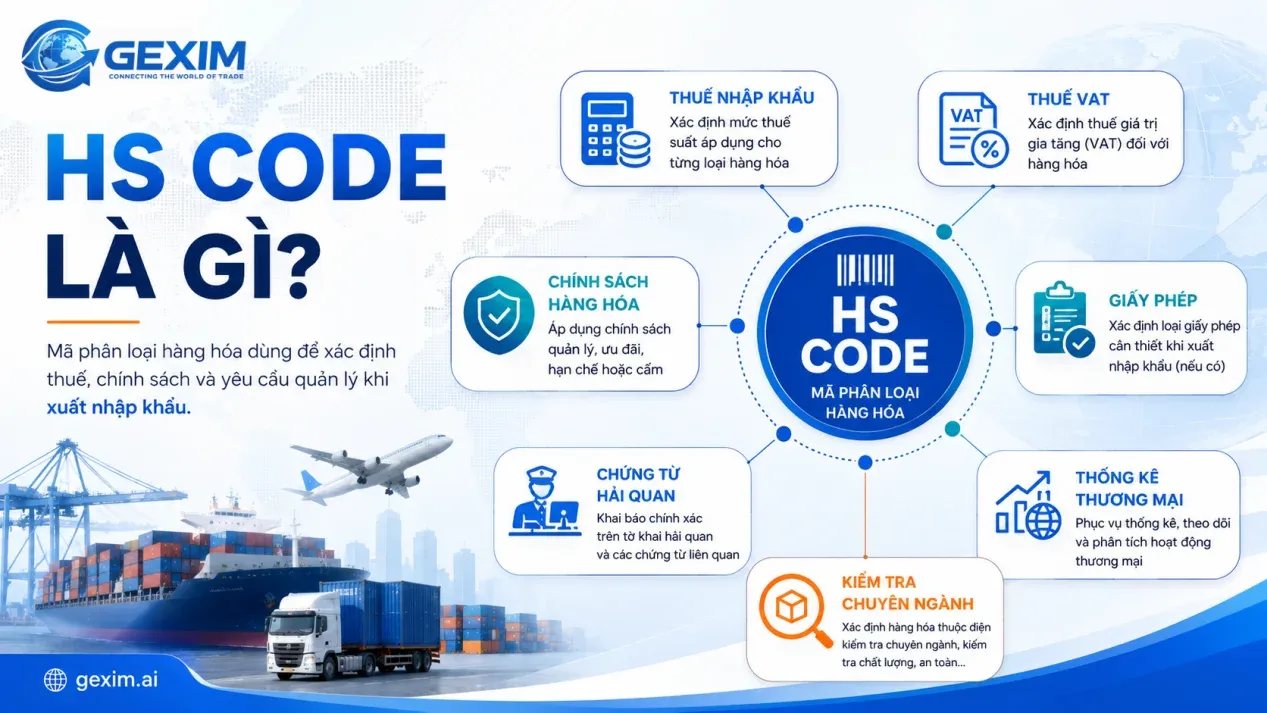
What is an HS Code? Structure and usage in import & export
An HS Code is a product classification code used in trade. Learn about the HS code structure, its digits, and its impact on duties and trade policies.

Top online HS code lookup websites and how to verify reliable sources
Recommended reputable websites for online HS code lookup such as Customs, VNTR, WCO, WTO, USITC, Access2Markets and how to use GEXIM for faster check.
Customs HS Code Lookup: Official Sources & Verification Methods
Guide on customs HS code lookup from official sources, how to check HS codes, and cross-reference results before declaring.
Suggested content you might be interested in
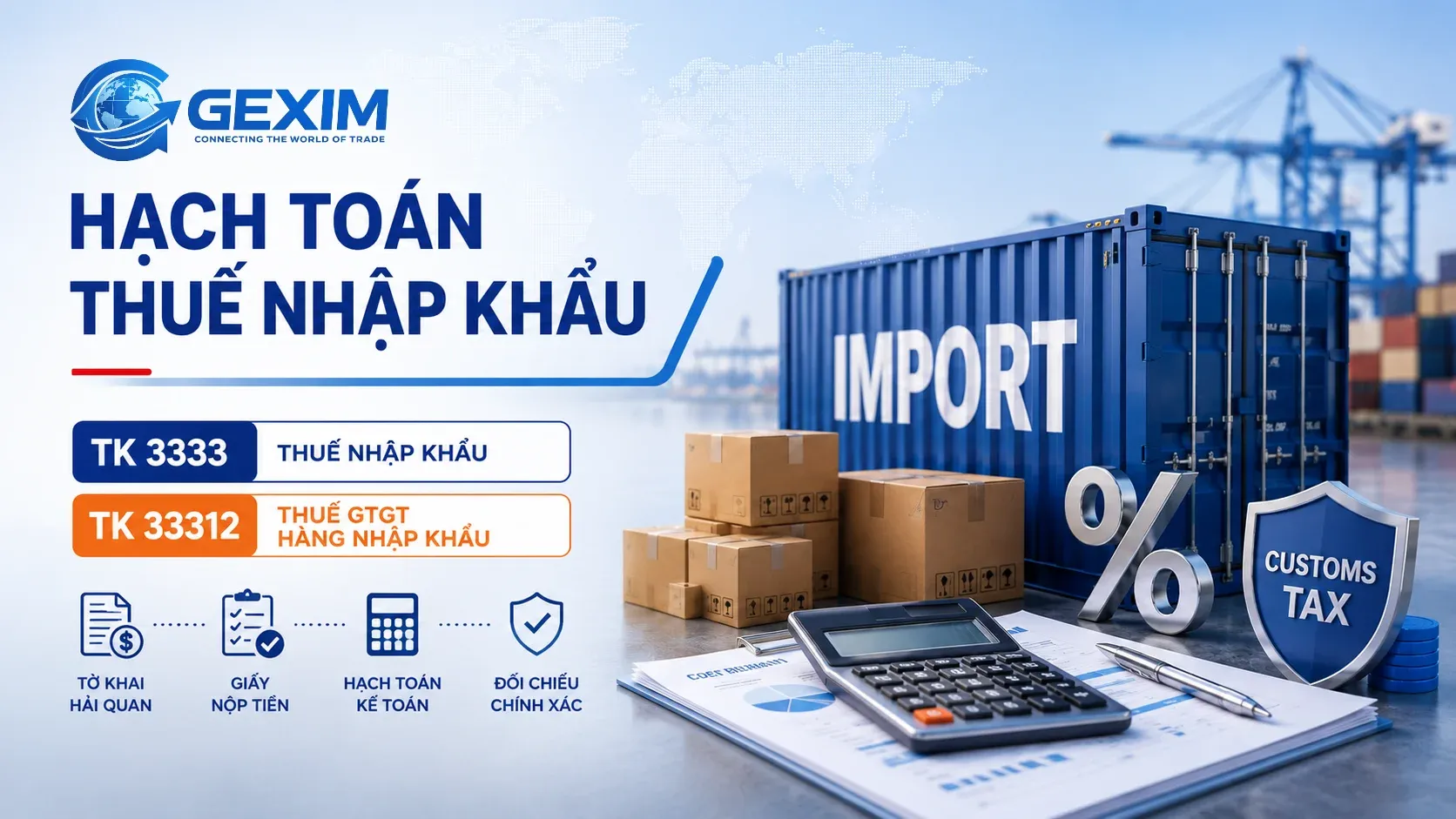
Accounting for import duty and import VAT: Account 3333, Account 33312
Detailed guide on accounting for import duty (Account 3333), import VAT (Account 33312), tax payments, and accounting reconciliation.

How to calculate import duty on goods entering Vietnam: formulas, examples and a checking workflow
The import-duty formula, how to set the dutiable value, how import VAT is computed, worked examples and a pre-declaration checking workflow.
What is the import customs value? Determining the customs value, CIF, FOB and exchange rates
What the import customs value is, why not to use the raw invoice price, how to determine it from CIF/FOB, the customs exchange rate and a document checklist before computing duty.